Prequalified Offer Marketplace: From Feature to Revenue

Key takeaways
A prequalified offer marketplace is an in-product surface where your users see credit-card, loan, insurance, or auto offers they'll actually qualify for, matched against their credit profile in real time.
Prequalified offers convert at multiples of cold-list response rates, and each accepted offer pays a bounty or revenue share.
A prequalified offer marketplace drives repeat opens between statements and materially lifts DAU, session length, and downstream cross-sell.
Building it in-house takes a year or more. Embedding a partner takes a sprint.
Evaluate partners on five axes: white-label depth, catalog breadth, latency, attribution, and who owns FCRA compliance.
A prequalified offer marketplace is an embedded in-product surface that shows users credit, loan, and insurance offers they are likely to be approved for based on a soft-pull credit match, and pays the host a revenue share on every conversion. It turns a credit feature from a cost center into a revenue line. That changes the P&L conversation. If your app has an audience and a flat non-interest revenue line, this is the biggest lever you're not pulling.
What is a prequalified offer marketplace, actually?
It's a component you embed in your app or portal that shows personalized credit and financial offers a user is likely to be approved for, based on a soft-pull view of their credit. Cards, personal loans, auto refinance, HELOC, insurance, sometimes telecom or retail credit. The user sees offers they can act on. You earn a revenue share on the ones they accept.
Two distinctions worth pinning down. Prequalified is not preapproved: it's a match against likely-approval criteria, not a binding commitment. And a prequalified offer marketplace is not a single-issuer white-label. Multiple lenders compete for the same user, which is what makes the economics work.
Why does prequalified beat cold?
Prequalified beats cold because users only see offers matched to their credit profile, which lifts click-through and application rates materially and lets lenders pay more per referral. The mechanics are simple.
Cold offers convert in the low single digits on a good day. Users see a promotion that doesn't apply to their credit tier, ignore it, and trust your inbox slightly less next time.
Prequalified flips the pattern. Because approval odds are already built in, lenders will pay materially more for a prequalified referral than a cold lead. And the compounding effect is what moves the P&L. Relevance drives return visits. Return visits turn your app into something people open between statements. Engagement metrics stop being the meeting you dread, and your cross-sell surface widens materially.
Where does the revenue come from?
Revenue arrives on three stacked lines: per-offer bounty or revenue share, engagement lift that compounds cross-sell, and first-party intent data. The bounty is the largest of the three.
Start with the bounty. A card approval pays a fixed fee, a loan origination pays a percentage of funded amount, an insurance policy pays a commission. This is non-interest income you didn't have last quarter, with no balance-sheet exposure.
Engagement lift stacks on top. A prequalified offer marketplace gives users a reason to log in when nothing is broken. It drives DAU and session length, plus the downstream conversion of every other product in your app.
The data exhaust is the sleeper. Every offer view, click, and application tells you what your users actually want, at a resolution your marketing team has never had. That data makes every downstream campaign work harder.
A well-tuned marketplace typically contributes meaningful non-interest ARPU at scale. Your number depends on catalog depth and audience credit mix.
What does the build-vs-buy math really look like?
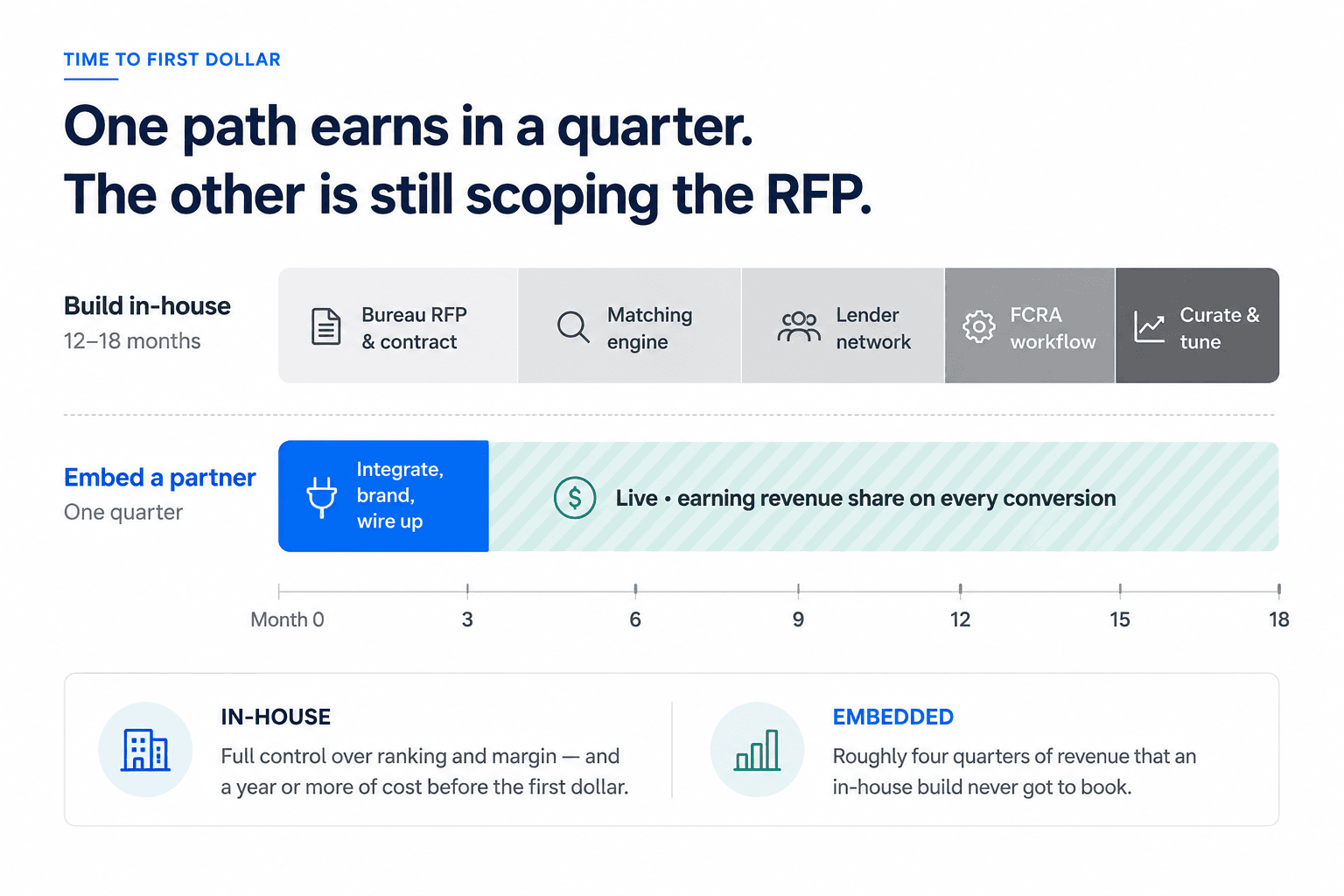
For all but the largest banks, embedding a partner beats building. An embedded marketplace launches in a quarter versus twelve to eighteen months in-house, and starts producing revenue while an in-house build is still scoping the bureau RFP.
Building in-house is a program, not a project. You need a bureau contract with soft-pull capacity, an offer-matching engine, a lender network that returns decisions in real time, an FCRA-compliant disclosure and adverse-action workflow (per 15 U.S.C. §1681), and a team to curate offers and tune the matching model on an ongoing basis. Twelve months is the deck estimate. Eighteen is the honest one.
Embedding a partner compresses that to a quarter, sometimes less. The partner brings the bureau relationship, the lender network, the matching engine, and the compliance surface. You bring the audience, the brand, and where the marketplace lives in your product.
In-house means full control over ranking and margin. Embedded means faster time-to-first-dollar and a smaller compliance footprint. Outside the top handful of banks, the math usually favors embedding.
What should you look for in a prequalified offer marketplace partner?
Five things worth pressing on in every vendor conversation.
White-label depth. Is it your brand end-to-end, or a co-branded module with the partner's logo in the corner? Anything short of full white-label leaks brand equity you spent years building.
Catalog breadth. How many lenders, across how many product categories? A card-only marketplace caps your revenue ceiling. A cross-product catalog compounds.
Latency and match quality. Soft-pull, decisioning, and offer rendering should feel instant. If your users see a spinner, they leave.
Attribution and reporting. You need per-offer, per-user attribution flowing into your analytics stack. Revenue you can't attribute is revenue you can't defend to finance.
Compliance ownership. Who signs the bureau agreement, who handles adverse-action notices, who owns the audit response. A serious partner takes most of this on. Get it in writing.
One more filter. Consumer credit is not a category where you want a vendor learning on your users. Fifteen years running this in production for everyday people beats any demo.
Prequalified offer marketplace FAQ
Is a prequalified offer a guarantee of approval? No. Prequalification uses a soft-pull view of the applicant's credit to match them to offers they're likely to qualify for. Final approval depends on a hard-pull review by the lender at the point of application.
Does prequalification affect a user's credit score? No. Prequalification uses a soft pull, which doesn't affect the score. A hard pull only happens if the user actually applies for the offer, and that's disclosed at the point of application.
How long does an embedded marketplace take to launch? A well-scoped embedded launch typically runs a quarter, sometimes less. The variable is your side: brand approvals, placement design, and getting the analytics wiring right.
How is a prequalified offer marketplace different from a single-issuer white-label? A single-issuer white-label offers products from one lender. A marketplace offers products from many, which drives higher approval rates, a better user experience, and materially better unit economics.
